

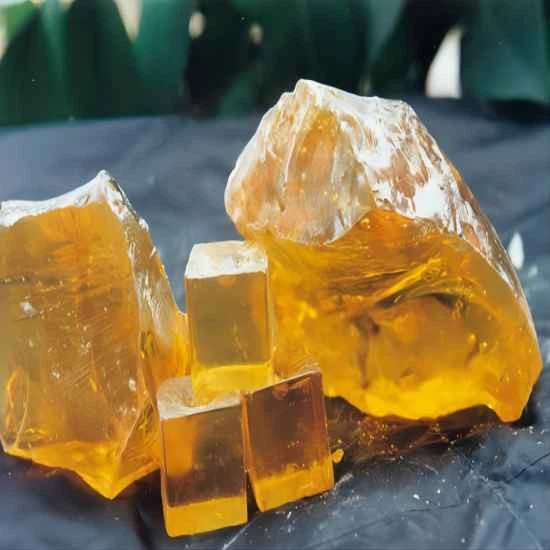
Yellow rosin, a natural resin derived from pine trees, has long been recognized for its remarkable ability to enhance the performance of adhesives. As a dedicated yellow rosin supplier, I've witnessed firsthand how this versatile material can transform ordinary adhesives into high - performing bonding agents. In this blog, we'll explore the various ways yellow rosin contributes to the improved performance of adhesives.
Tackiness and Initial Bonding
One of the primary ways yellow rosin improves adhesive performance is by increasing tackiness. Tack is the property of an adhesive that allows it to form an immediate bond upon contact with a substrate. When yellow rosin is added to an adhesive formulation, it imparts a high degree of tack, enabling the adhesive to quickly adhere to surfaces.
This is particularly important in applications where a fast - setting bond is required, such as in packaging, labeling, and tape manufacturing. For instance, in the production of pressure - sensitive adhesives (PSAs), yellow rosin helps the tape stick firmly to different surfaces right after it is applied. The resin's natural stickiness fills in the microscopic irregularities on the substrate, creating a strong initial bond. This immediate adhesion reduces the risk of the adhesive slipping or shifting during the early stages of application, ensuring a reliable and long - lasting bond.
The tack - enhancing properties of yellow rosin can be attributed to its unique chemical structure. It contains a variety of resin acids, such as abietic acid and pimaric acid, which have polar functional groups. These polar groups interact with the surface of the substrate through van der Waals forces and hydrogen bonding, facilitating the formation of a strong initial bond.
Adhesion Strength
In addition to tackiness, yellow rosin significantly improves the overall adhesion strength of adhesives. Adhesion strength refers to the force required to separate the adhesive from the substrate. By adding yellow rosin, adhesives can better adhere to a wide range of materials, including metals, plastics, and wood.
When bonding dissimilar materials, the differences in surface energy can pose a challenge for adhesives. Yellow rosin acts as a compatibilizer, reducing the surface energy differences between the adhesive and the substrate. This allows the adhesive to wet the surface more effectively, increasing the contact area and enhancing the adhesion strength.
For example, in the automotive industry, adhesives containing yellow rosin are used to bond plastic components to metal frames. The yellow rosin helps the adhesive form a strong bond between the two materials, ensuring the structural integrity of the vehicle. Similarly, in the woodworking industry, yellow rosin - enhanced adhesives provide excellent bonding for joints, improving the overall strength and durability of wooden products.
Cohesion
Cohesion is another crucial aspect of adhesive performance, referring to the internal strength of the adhesive itself. Yellow rosin contributes to the cohesion of adhesives by acting as a cross - linking agent. It can form intermolecular bonds within the adhesive matrix, creating a more rigid and stable structure.

In hot - melt adhesives, for instance, yellow rosin helps to prevent the adhesive from flowing or deforming under stress. The resin forms a network of bonds that holds the adhesive molecules together, increasing its resistance to shear and peel forces. This is especially important in applications where the adhesive is subjected to mechanical stress, such as in the assembly of furniture or the construction of buildings.
Heat Resistance
Yellow rosin also enhances the heat resistance of adhesives. In many industrial applications, adhesives are exposed to high temperatures during processing or use. Without proper heat resistance, the adhesive may soften, lose its bond strength, or even decompose.
The high melting point and thermal stability of yellow rosin make it an ideal additive for improving the heat resistance of adhesives. When incorporated into an adhesive formulation, yellow rosin raises the glass transition temperature (Tg) of the adhesive, which is the temperature at which the adhesive changes from a hard, glassy state to a soft, rubbery state.
For example, in the electronics industry, adhesives used for circuit board assembly need to withstand high - temperature soldering processes. Adhesives containing yellow rosin can maintain their bond strength and integrity even at elevated temperatures, ensuring the reliability of electronic components.
Compatibility with Other Ingredients
Yellow rosin is highly compatible with a wide range of other adhesive ingredients, such as polymers, solvents, and fillers. This compatibility allows formulators to create custom - tailored adhesive formulations that meet specific performance requirements.
It can be easily blended with synthetic polymers, such as styrene - butadiene rubber (SBR) and ethylene - vinyl acetate (EVA), to enhance their adhesive properties. The combination of yellow rosin and these polymers results in adhesives with improved tack, adhesion, and cohesion.
Moreover, yellow rosin can also be used in solvent - based and water - based adhesive systems. In solvent - based adhesives, it helps to dissolve other components and improve the solubility of the adhesive. In water - based adhesives, yellow rosin can be emulsified to form a stable dispersion, providing similar performance benefits as in solvent - based systems.
Availability of High - Quality Yellow Rosin
As a yellow rosin supplier, I'm committed to providing high - quality products to meet the diverse needs of our customers. We offer Pure Rosin, which is carefully processed to ensure a high level of purity and consistency. Our Quality Rosin is sourced from sustainable pine forests, guaranteeing a reliable supply of this valuable natural resource.
We also operate a Pure Rosin factory, where we implement strict quality control measures throughout the production process. This ensures that our yellow rosin meets the highest industry standards and provides optimal performance in adhesive applications.
Conclusion
Yellow rosin is a valuable additive that can significantly improve the performance of adhesives in multiple ways. From enhancing tackiness and adhesion strength to improving cohesion and heat resistance, its benefits are undeniable. As a yellow rosin supplier, I'm excited to offer high - quality products that can help adhesive manufacturers create innovative and high - performing bonding solutions.
If you're in the market for yellow rosin to improve your adhesive formulations, I encourage you to reach out for a procurement discussion. We can work together to find the best yellow rosin product that meets your specific requirements and helps you achieve outstanding results in your adhesive applications.
References
- Pizzi, A., & Mittal, K. L. (Eds.). (2003). Handbook of Adhesive Technology. Marcel Dekker.
- Bikerman, J. J. (1961). Adhesion and Adhesives. Reinhold Publishing Corporation.
- Stuart, B. H. (2004). Infrared Spectroscopy: Fundamentals and Applications. Wiley.