


Rosin
What is Rosin
Rosin is a concentrate created when dried trichomes are collected and then compressed using heat. This process creates a sticky, potent, solvent-free concentrate rich in flavor and aroma. Rosin can be both purchased at a dispensary or made at home using a rosin press. Fresh resin is heated to vaporize terpenes and form a semi-transparent compound that ranges in color from yellow to black.
Advantages of Rosin
Rosin is completely free from solvents
One of the main differences between Rosin and other types of concentrates is that the extraction process doesn't require solvents. Many extracts involve butane, CO2, or other solvents to separate the trichomes. The problem is that these concentrates can sometimes be left with residual solvents.
You'll get strong effects from a small amount
Rosin is one of the best choices for users who want something more powerful. Strains of flower usually contain anywhere from 15-25% THC. While this is enough to provide enjoyable effects, users with high tolerance levels often need to smoke a lot to get the effect they want.
Rosin's Potency is What Makes it Stand Out
Rosin is a solventless extraction process which means that the rosin extract's potency will be upwards of 100% with certain compound levels. Other concentrates or extracts, like shatter or waxes more often peak out in the 90-99% range.
Rosin's Purity is Unmatched
Rosin concentrates are a high-quality extract that is made from flowers, not butane or other solvents. This means rosin does not have any of the unpleasant tastes, smells, and harshness often found in traditional extracts like shatter or wax.


Why Choose US
Our Factory
Wangmo County Tonghong Trading Co., Ltd , established in 2010, is an international trading company integrating R & D, production, sales and consignment. Our company from the establishment up to now, has an area of more than 900 acres of factories and planting base, the laboratory is also beginning to take shape at the present stage.
Our Product
At present, it specializes in the import and export business of tung oil and its related by-products. Also, the company has dealt in agricultural and sideline products such as oil tea seeds, camellia oil and linseed oil since 2015.
Our Certificate
Our management system has passed ISO9001 international certification. We also have a lot of patented production equipment.
Our Service
Our professional staff will follow up in time. We will carefully understand the needs of customers to provide customers with intimate service.
What to Look for When Buying Rosin
Since the quality of starting material is directly reflected in the final output, it is easy to identify subpar SHO. Here's what to look for:
Color
Good oil has a clean, light amber or tan color. It is consistent in color and shatter and sap forms should be translucent.
A green color indicates that plant matter (chlorophyll) is present. Plant matter can also look like small specks or hairs.
A dark color means older starting material, but that doesn't necessarily mean it is poor quality.
Smell
Since the output directly reflects the input, quality product smells like the flower it came from. If it has no smell, it's no good. Likewise, you want to avoid any with a hay-like smell.
Taste
Similar to smell, quality extract will reflect the flavor of the input material. That is why it is so important to use high quality material when extracting rosin. It is the main factor impacting quality.
What Are the Different Types of Rosin
Flower Rosin
We've mentioned that rosin is most commonly made using kief. Well, it can also be made by applying heat and pressure to the actual flower bud. This process keeps a lot of the plant material in the rosin, including fats and oils. While flower rosin might be a little faster and easier to make and create a larger yield, you'll notice a different flavor and what some cannabis enthusiasts say is a less desirable flavor.
Hash Rosin
Hash rosin is probably the most popular rosin product on the market, and it's made by first extracting kief using an ice water technique and a variety of screen bags that collect those tiny trichomes. Once collected, the kief is compressed into hash, and then the hash is placed in a rosin press. What you're left with is a top quality, highly potent concentrate without a lot of the plant material found in flower resin. Out of all the ways to make rosin, this one is the most complicated and requires the most skill to ensure you preserve as many trichomes as possible to make your final product.
Dry Sift Rosin
If you want a slightly less messy method of making rosin, dry sift rosin might be the answer. First, the cannabis flower is broken into pieces and laid out on screens—each screen finer than the last. Then, the flower is carefully sifted back and forth over the screen to knock the trichomes from the bud. While time consuming, this technique requires less skill when compared with hash rosin.

Rosin concentrate extraction involves using a heat source to create pressure between two surfaces, typically metal plates lined with parchment paper or silicone. Plant material is then heated until the contents are liquified enough for it to be drawn out from one side and then solidified into a hard wax on the other without coming into contact with anything but air.
When it comes to creating rosin from terpene rich flower and/or plant material, concentrates take a plant product like flower, shake, or kief then adds heat and high pressure to produce a solventless extract. It is a quick and simple process that yields a golden sap with extremely high potency. Even better, no solvents are used in production like with extracts.
What you get with rosin is an all-natural product at its purest form. What's the difference between extracts and concentrates? The main distinction has to do with how they're made and what, if any, type of solvents were used during production processes.
Extracts, for example, are made using solvents. The solvents chemically extract the desired compounds and/or their components. Concentrates are made through a mechanical process that typically includes heat and pressure.
Extracts
Extracts are created using solvents. Some of the most commonly used solvents are butane, propane, CO2, and ethanol. Using these methods, the final extract will have its own features as far as appearance, flavor, and potency depending on what solvent was used. The same methods can produce extremely different results when it comes to flavor and consistency, depending on the quality, the type of plant matter used, and what techniques were utilized.
Shatter, for example, typically needs butane extraction process while others require a different solvent such as propane or naphtha. All of these will have very similar potencies, however.
Concentrates
Concentrates, on the other hand, are an all-natural product made by heating up plant flowers under pressure until they release their resin glands. These contain potent doses of beneficial and desirable compounds which can be extracted through a quick and easy process that produces high quality concentrates with the highest levels of potency.
It's worth noting that these concentrates offer nearly pure extracts coming at potency rates in the upper 90 percentiles. Many people don't realize how versatile these type of concentrations are - used for everything from vaping to being eaten as candy!
Terpenes
Terpenes are aromatic oils that give many plant varieties their distinctive flavor such as citrus, berry, mint, and pine. The human body absorbs these more quickly through inhalation because they don't have to go through the digestive process.
For many strong-smelling plants and flowers, the development of terpenes began as an adaptive mechanism to deter predators and attract pollinators. There are many factors that influence a plant's development of terpenes including climate, weather, age, maturation, fertilizers, soil type, and even the time of day.
To produce rosin, manufacturers begin by selecting high-quality and properly manicured cannabis flowers. The harvested buds are immediately frozen to preserve their terpene profile and prevent degradation. These frozen buds contain trichomes, which house cannabinoids such as THC and CBD, along with compounds known as terpenes.
Once the frozen buds have undergone curing, they are gently pressed between two plates using a hydraulic press.
When heat and pressure come together, it causes the trichomes to burst, releasing an oil. This oil is carefully collected by scraping it off the plates.
After collection, the scraped resin is left to cure for hours until it reaches its consistency. It becomes a flavorful live rosin that is ready to be used!

Rosin versus Resin: What's the Difference
It's easy to confuse these cannabis concentrates since they sound so similar. Broadly speaking, rosin is solventless and typically produced through heat and pressure, without any chemicals. While resin, on the other hand, is a sticky substance secreted by trichomes on cannabis plants. It can also be a type of extract processed through a solvent extraction method using chemicals such as propane and butane.
Both rosin and resin are made from the dried cannabis material. If you encounter such other terms as “live rosin” and “live resin”, those extracts were produced using frozen herbs instead of dried flowers. Generally, the process of making rosin is more labor-intensive and costly, so this concentrate is more expensive than resin. But it offers a cleaner extract since making rosins doesn't involve using any chemicals. In contrast, resins require solvents and a closed-loop system, and they should only be produced by licensed professionals in a certified laboratory. These products can only be purchased in a legal market that requires product testing.
Potency
As you decide between these two cannabis concentrates, it's important to focus on their relative potency. Generally, resins are more potent than rosins since their production is a bit more complex and exacting. Solvent extraction produces a maximum amount of THC with every batch. Rosin production is more accessible and less stringent, so the THC levels are not as high. But that's not to say rosins are impotent- they are simply not as strong as resins.
Effects
Resin is more potent than rosin, but the effects of these two cannabis concentrates are almost similar. If they are sourced from the same marijuana breed, it's possible extracts would produce similar benefits at varying levels. But as underscored, they are two different products with specific properties. The effects of these extracts may also depend on external factors, especially how you consume them.
Due to the solubility, volatility, and the principle that rosin can quickly condense into a "strong and transparent film" after volatilization, painters usually make their own "fixed drawing" liquid to protect the picture and prevent "sketching" from being rubbed off. That is, one part of rosin powder, nine parts of alcohol, or a solvent ratio of xylene. First, place the rosin in a well sealed glass container, then pour alcohol or xylene into it, cover it, and dissolve it on their own after two days. When in use, shake well and pour into a spray can, 20 centimeters away from the screen. Spray evenly onto the screen, spray at any time, and evaporate at any time. After a few minutes, it will dry completely, and you won't be afraid of being rubbed off in the future. Attention: Rosin should not be excessive as it will turn yellow and dark.
Hydrogenated rosin glyceride can be heated and melted with natural gum, wax, vinyl acetate, etc., and then mixed with spices, sugar, and pigments to make chewing gum. When slaughtering pigs, cows, and sheep in the slaughterhouse, the hair left on the animal body and head can be removed using a hair removal agent composed of 88-94% molten rosin and 6-12% cottonseed oil after being operated by a hair removal machine.


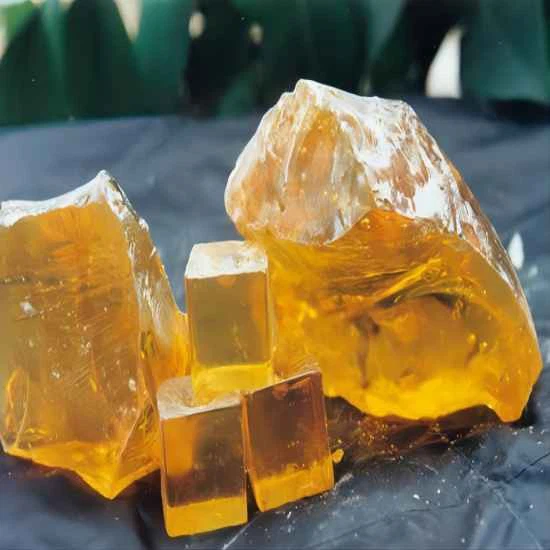
Rosin can be divided into three types based on its source: resin rosin, wood rosin, and floating oil rosin. Rosin, also known as rosin, has a light color, high acidity, and a high softening point; Pinus massoniana, also known as extracted rosin, is inferior in quality to resin rosin, has a dark color, low acidity, and is prone to crystallization from certain solvents; Floating oil rosin, also known as tall oil rosin. Rosin is a transparent and brittle solid natural resin, which is a complex mixture composed of resin acids (abietic acid, sea pine acid), small amounts of fatty acids, rosin anhydride, and neutral substances. The main component of rosin is resin acid, accounting for about 90%, with a molecular formula of C19H29COOH and a molecular weight of 302.46. Resin acid is the most representative rosin acid, belonging to unsaturated acids, containing conjugated double bonds, strongly absorbing ultraviolet light, and can automatically oxidize or induce post oxidation in air. Rosin has a light yellow to light brown appearance, with a glassy luster and a turpentine odor, with a density of 1.060-1.085g/cm3. Belonging to amorphous, without a melting point, with a softening point (global method) of 72-76 ℃ and a boiling point of approximately 300 ℃ (0.67 kPa). The glass transition temperature Tg is 30-38 ℃. The refractive index is 1.5453. Flash point (open cup) 216 ℃. The ignition point is approximately 480~500 ℃. Easy to oxidize in the air and darken in color.
How to Properly Store Rosin
Avoid extreme temperatures
Extreme temperatures, whether too hot or too cold, can cause live rosin to degrade quickly and lose its potency. Keep temperature consistent: Fluctuations in temperature can also cause live rosin to degrade, so it's best to keep the temperature consistent and avoid sudden changes. Keep away from heat sources: It's important to keep live rosin away from any heat sources such as stoves or ovens to prevent it from being exposed to high temperatures.
Store in a cool, dark place
Live rosin concentrates should be stored in a cool place to prevent heat exposure and degradation. Limit light exposure and keep your rosin in a temperature-controlled environment. To ensure the temperature stays consistent, you may consider storing your live rosin in a temperature-controlled environment such as a wine fridge or a cool, dark cabinet. If you're storing live rosin for an extended period, storing it in the freezer can help to preserve its potency, as long as the temperature doesn't go below -18°C.
Factor in humidity
Humidity plays a critical role in the proper storage of cannabis rosin concentrates. If stored in an environment with too little humidity, the rosin can butter up, becoming brittle and dry. Essentially it loses a lot of its potency and terpenes.
Storing rosin in an environment with too much humidity can add moisture to the rosin. That’s what makes that crackle and pop you may have heard while dabbing. The ideal humidity level for storing rosin is between 55-62.
Keep in an airtight container
Exposure to air can cause the live rosin to oxidize and lose potency, so it's important to store it in an airtight container. Use a non-reactive container: Live rosin can react with certain materials, so it's important to store it in a non-reactive container such as a glass jar or silicone container. Avoid plastic containers: Plastic containers can leach chemicals into the live rosin, so it's best to avoid storing it in plastic. For storing longer periods of time, it is advised to vacuum seal your containers and jars.
Store rosin in small amounts
Storing cannabis rosin in small amounts is essential to preserve its quality and potency. When rosin is exposed to air and light, it can quickly degrade, causing a loss of terpenes and cannabinoids. By storing rosin in smaller amounts, you can reduce the exposure to air and light, slowing down the degradation process.
FAQ
We're professional rosin manufacturers and suppliers in China, specialized in providing high quality customized service. We warmly welcome you to wholesale discount rosin in stock here from our factory. Contact us for free sample.
camellia seeds pods, Bulk Rosin, natural organic camellia oil